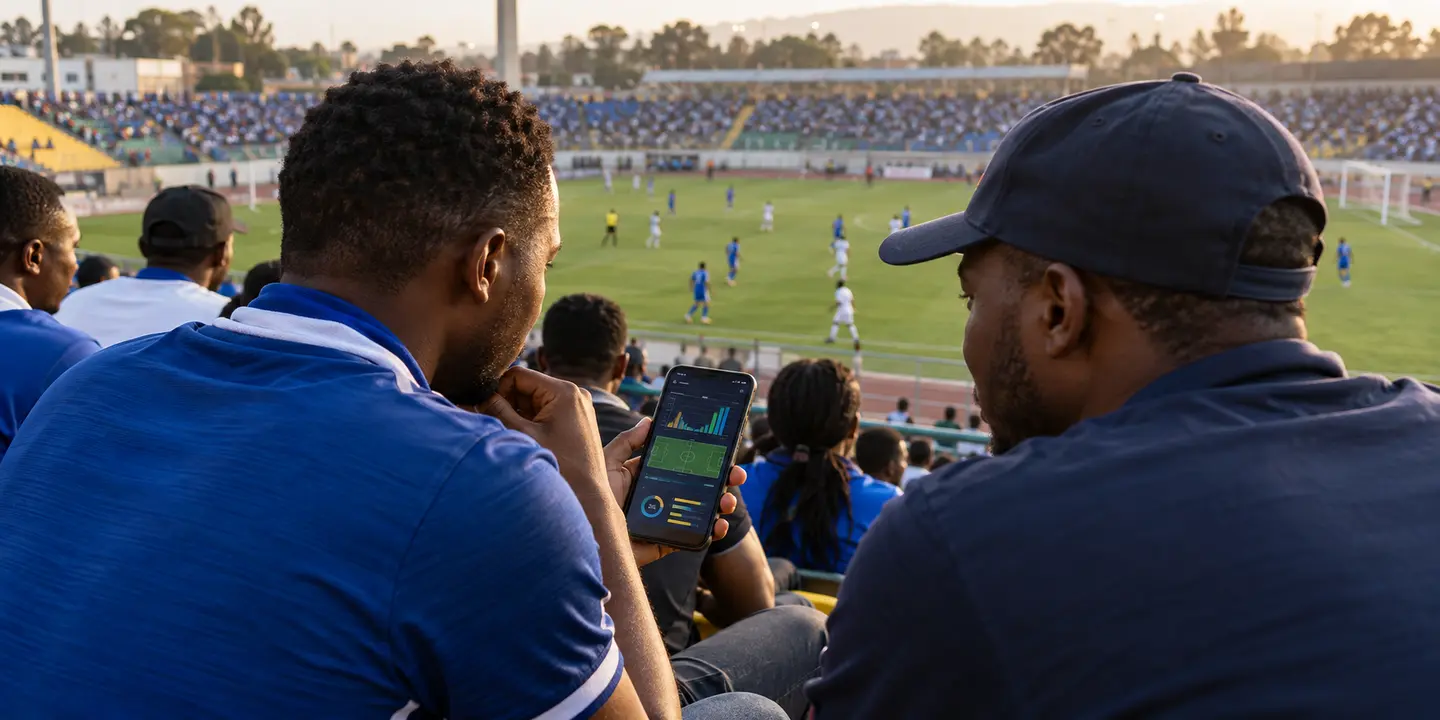
Sports betting is a regulated activity in Rwanda. The market is mobile-led, with football receiving the largest share of attention, followed by basketball, tennis, eFootball and other international competitions.
Before choosing a platform
Check five things before registering:
- The operator identifies the legal company serving Rwanda.
- The exact domain is connected to the stated licence.
- Deposits and withdrawals are currently operating.
- Taxes and payment charges are clearly disclosed.
- Responsible-gambling and account-suspension tools are available.
Common bet types
| Market | Plain-English meaning |
|---|---|
| 1X2 | Home win, draw or away win |
| Double chance | Two of the three 1X2 outcomes |
| Over/under | Whether the total exceeds a stated line |
| Both teams to score | Whether each team scores at least once |
| Accumulator | Multiple selections combined into one ticket |
| Live betting | Markets offered after an event has started |
An accumulator can produce a larger displayed return, but every selection must normally win. Adding selections also increases the probability that the full ticket loses.
Taxes matter
Published operator notices indicate that winnings may be subject to withholding tax. Always assess the net amount you could receive rather than focusing only on the displayed gross return.
Mobile-first use
Many Rwanda-facing platforms are designed for lower-data mobile access. Even so, avoid placing a bet on an unstable connection. Confirm that a ticket appears in the account history before trying to submit it again.
Pre-match versus live betting
Pre-match markets allow more time to read the rules and compare prices. Live markets move while the event is underway and may be suspended after a significant incident. A broadcast can lag behind the market data feed, so the picture on a screen is not necessarily the operator’s current event state.
For either format, the accepted ticket—not the earlier preview—is the final record. Check the event, market, line, price, stake and possible return before leaving the confirmation screen.
Settlement rules to read
Football bets may settle on 90 minutes only, excluding extra time and penalties. Tennis retirements, postponed matches and abandoned events can follow product-specific rules. An apparent prediction of the sporting outcome is not enough if the selected market has a different settlement definition.
Keep the ticket reference until settlement. If the result appears incorrect, compare the market wording with the operator’s published rules before contacting support.
Comparing net value
Two sites showing slightly different odds can also have different taxes, deposit charges and withdrawal fees. Calculate the probable net wallet amount rather than choosing on headline odds or a bonus alone.
Availability also matters. A brand with visible markets but paused deposits cannot be evaluated in the same way as a fully functioning payment service.
Frequently asked questions
Is sports betting legal in Rwanda?
Rwanda’s policy framework provides for licensed sports betting through physical shops and authorised online platforms. Users should still confirm the operator, licence and exact domain.
Which sport has the most markets?
Football usually has the widest coverage, followed by sports such as basketball, tennis and virtual or eFootball events.
Are accumulators better than single bets?
They offer a larger displayed return by combining prices, but every included selection normally has to win. Adding legs increases the number of ways the ticket can lose.
Understanding the Rwanda regulatory context
Rwanda’s 2024 Gambling Policy describes sports betting as wagering on real or virtual sporting events and allows it through licensed shops or authorised online platforms. It also sets a direction toward stronger monitoring, identity controls, responsible-gambling measures and consumer protection.
For a player, regulation is not just a logo in a footer. The relevant checks are the operating company, the licence category, the domain used for the service and the payment recipient. A company may hold permission for one activity without every visible product being available under the same conditions.
Rules and enforcement can change. That is why RwandaPlay dates material checks and gives current operator or government notices priority over undated promotional pages.
Building a football ticket carefully
Start by identifying the exact competition, teams and scheduled time. Then choose one market whose settlement you understand. A match-result selection, total-goals line and both-teams-to-score selection describe different questions even when they concern the same fixture.
Read whether the market covers normal time only. In most football contexts, 90 minutes includes stoppage time but excludes extra time and penalties. Cup matches can therefore produce a winning team after extra time while a normal-time match-result bet settles as a draw.
Check the accepted price after submission. If the account setting automatically accepts all price changes, the final ticket may carry a lower return than the preview. Consider using a setting that requires confirmation when the price changes.
Basketball, tennis and other sports
Basketball markets commonly include match winner, point spread and total points. Overtime treatment can differ by market, so the rules must state whether it counts. A spread gives one side a virtual advantage or disadvantage for settlement; it does not change the real match score.
Tennis requires particular attention to retirements and walkovers. Operators may settle match-winner and set markets differently depending on whether a player completed a set or the match. Do not assume that every unfinished match is simply void.
eFootball and virtual events can run frequently, which can encourage rapid repeated betting. Frequency does not improve predictability. Apply the same time and money limits used for real sport.
Odds comparison and operator margin
Decimal odds show a gross return including the returned stake. They can also be converted into an implied probability by dividing one by the price. For example, odds of 2.00 imply 50% before allowing for the operator’s margin.
Adding the implied probabilities for every outcome often produces more than 100%. The excess is one way of understanding the built-in margin. A market with a lower overall margin may offer better theoretical value, but it still does not create a guaranteed winning strategy.
Compare like with like: the same event, market, line and settlement terms. A higher price is not meaningfully better if the payment service is unavailable or the eventual wallet amount is reduced by additional charges.
Withholding tax and transaction costs
The number displayed on a ticket is usually a gross figure. Rwanda-facing operator notices indicate that withholding tax can be deducted from winnings, and mobile-money fees may apply to deposits or withdrawals.
Before confirming a stake, estimate the net return after the stated deductions. This makes different ticket sizes and operators easier to compare and prevents a gross headline from being mistaken for the amount that reaches the wallet.
Keep payment costs separate from sporting analysis. Increasing a stake to compensate for a fee also increases the amount exposed to loss.
Common mistakes
- Selecting a first-half market when intending to bet on the full match.
- Assuming extra time counts without reading the rules.
- Repeating a ticket because the mobile connection appeared to freeze.
- Copying a booking code without checking its changed prices and events.
- Treating a long accumulator as safer because it includes favourites.
- Increasing the next stake to recover a previous loss.
- Using money reserved for transport, food, rent or debt.
A practical session plan
Decide three numbers before opening the platform: the maximum amount for the session, the maximum stake per ticket and the time at which you will stop. These limits should not depend on whether the first result wins or loses.
Record completed stakes rather than only the current balance. Deposits, withdrawals, fees and open bets can make the balance a poor measure of total spending. A simple weekly record gives a clearer picture.
When the limit is reached, close the session. There is no market that must be taken immediately, and a missed bet costs nothing. If stopping becomes difficult, use account suspension or self-exclusion and seek support.
Choosing between operators
Begin with licence and company transparency, then current payment availability, withdrawal conditions, support and player controls. Only after those checks should market range and odds influence a decision.
This order matters because a broad catalogue has little practical value when deposits are paused, withdrawals are unclear or the account cannot be restricted. A responsible comparison therefore treats operational reliability and consumer protection as product features.
Final checklist
Confirm the official domain, current service status, exact market, accepted price, settlement period, gross and estimated net return. Keep the ticket reference and never allow a single result to change a limit decided in advance.
A responsible approach
Treat betting as paid entertainment rather than a source of income. Set a fixed limit before opening an app, avoid borrowing, and stop when the limit is reached. If gambling is causing stress, debt or conflict, step away and request account restrictions.